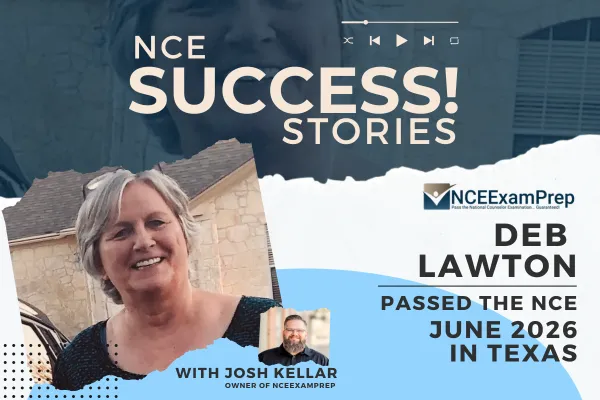
NCE Success Stories Podcast - Ep. 12 - Deb
What happens when you begin an entirely new career at 65?
In this episode of NCE Success Stories, I sit down with Deb, who passed the National Counselor Examination (NCE) on June 11, 2026, to talk about her inspiring journey into the counseling profession.
Deb began her career as a paralegal in 1983 and spent 23 years working in the oil and gas industry. After earning a doctorate in organizational leadership, she made the remarkable decision to return to school at age 65 to pursue a master's degree in Clinical Mental Health Counseling. Along the way, she gained experience working with teens in a residential treatment center, served youth and unwed mothers at a therapeutic ranch, and now works as a case manager conducting assessments for a Forensic Assertive Community Treatment (FACT) team.
In our conversation, Deb shares:
Why she decided to change careers later in life
The challenges and rewards of returning to graduate school
How she prepared for and passed the NCE
The study strategies that helped her succeed
Encouragement for anyone who feels it's "too late" to pursue their calling
Whether you're preparing for the NCE or considering a career change of your own, Deb's story is a powerful reminder that it's never too late to pursue meaningful work.
Learn more about the NCE Guaranteed Study Package:
https://pass.nceexamprep.com/guaranteedstudypackage
If you enjoyed this episode, be sure to subscribe and share it with another future counselor who could use a little encouragement.
Podcast Transcript
[00:00:00] Josh: Foreign.
Hello, and welcome to the NCE Success Stories podcast where we ask a counselor who's recently passed the national counseling exam all the burning questions that you have as you wonder how to pass with confidence. My name is Josh Keller and I'm the owner of nceexamprep.com and today I have with me Deb. Deb started as a paralegal in 1983 and worked in field for 23 years in the oil and gas industry. She also has a doctorate in organizational leadership. At age 65, she decided to go back to school for her master's in clinical mental health counseling. She has experience working with teens in residential treatment centers and a ranch for teens and unwed mothers. She currently works as a case manager doing assessments for a forensic assertive community treatment team. Deb, it's awesome to have you here. Thanks so much for joining me today.
[00:01:02] Deb: Well, you're welcome. It's nice to be here. And I'm, I'm hoping that my words can help those that, you know, are searching the same path I searched for.
[00:01:11] Josh: I'm sure that they will. I'm sure that they were. I've actually been very excited about meeting with you since I saw that you were interested, and I was thrilled to hear.
Was that a week or two ago that, that you passed. I can't remember.
[00:01:24] Deb: Yep. June 11th.
[00:01:26] Josh: June 11th. Okay. It's June 22nd now, so.
Yeah. And you, you're in Texas. You passed in Texas. Okay, people.
[00:01:33] Deb: That's correct.
[00:01:34] Josh: Awesome. Awesome. So I want to hear just a little bit at first about how you celebrated. Like, I know we're gonna, we're gonna circle back to what the test was actually like, but what did you do to celebrate?
[00:01:47] Deb: The, the first thing I did was cry.
I, I, it was, you know, an unbelievable experience. Experience, you know, but, you know, anything specific that I did to celebrate was just to celebrate myself and, and know that, you know, it is possible to get through that exam.
I shared it with my supervisor that I'm going to have because she has been with me throughout this whole journey, it seems.
And then I did some other stuff for myself, like looked at all the books that I've been stacking up forever and deciding which one I wanted to start reading first.
[00:02:38] Josh: Okay.
[00:02:38] Deb: And, and that's basically how I celebrated myself. Just take myself away.
It took me a few days to box up all of my study materials, which didn't think I had that much, but I do have a pretty good sized box.
[00:02:57] Josh: Right.
[00:02:58] Deb: So, you know, I, I did stuff like that. So those Little, little bitty things to celebrate yourself can mean so much more.
[00:03:05] Josh: Oh, I love that. And I love that you had a, A book, a stack of books that. Waiting for you to read now that you don't have to study any of these other things anymore. So.
[00:03:17] Deb: Yes.
[00:03:18] Josh: Yeah. So you mentioned talking with your supervisor who's been with us along with you on this journey. It's been a journey for you getting to this point, hasn't it? Do you want to share with our listeners real briefly just about what that journey has been like for you?
[00:03:34] Deb: Yes.
I graduated with a master's in clinical mental health counseling in August of 2019.
I immediately started studying for the exam, and I can't even tell you how many times I took the exam and failed by 1 point, 2 points, 3 points, you know, and, and that those times were highly discouraging.
However, I found within myself that this is something I really want to do.
And, and now when I got into this field, I was 66 by the time I finished, and now I'm 74.
[00:04:22] Josh: Okay.
[00:04:22] Deb: But it's, it's my drive. It's the drive you have, the passion you have to be able to want to be in this field that drives you to keep trying.
You just have to keep trying because it will happen.
[00:04:41] Josh: That's awesome. That's amazing. And I, and I know that, that there are other individuals who are pursuing this as like a second or even a third career.
And so I think it's just amazing that you just pressed on and continued doing it. So tell me a little bit about some of the strategies that you used as you were preparing and studying that you found to be most effective.
[00:05:08] Deb: When, when I started this process, I didn't have any clue or any idea of, of any strategy.
And I came upon your program that provided the most structure for me.
And, and I admit I didn't follow it, you know, tooth and nail, sure. But I, but it was a structure that I needed because me, the opportunity to study, to categorize my weak. My areas into the strongest to the weakest. And I really focused on the weak areas more than I focused on the stronger areas.
And those strong areas would go up and down from, you know, higher points to lower points. But I ignored that because I knew where my weakest points were.
And I think that's really, was really important for me to really understand why those are weak points and to actually delve into.
Okay, why can't I understand what this means?
[00:06:23] Josh: Sure.
[00:06:24] Deb: So that was a strategy I used just to focus on my weak points. The weakest parts of the exam.
And I felt if I could do that, then the other ones would fall into place. And ultimately they did. It was a trial and error.
[00:06:43] Josh: Yeah.
[00:06:43] Deb: But ultimately it all fell into place.
[00:06:46] Josh: Yeah. That's great. And I think that that's. I mean, that that's kind of the beauty of the, the method is that, you know, a lot of people when they study, they feel really good studying the areas that they know because they know them. Right. It builds confidence. Right? Oh, yeah, I got that right. Right.
But sometimes if we do that to the neglect of our weaker areas, you know, that's where those missing points are on those ex.
And so even even though you didn't follow the. The plan exactly the way that it's written, there's still a lot of benefit from it. And, and that's kind of. The other thing is that it's very. It's very ambitious to complete the entire program.
But even if you don't complete the program, the structure that is there because it's repetitious is still very effective. And it sounds like you were able to experience that in. In your own path using it. So that's great.
[00:07:38] Deb: Yes. And I think it. I think it really helped because the program is set up is such that that it gives you different opportunities for videos and, and other methods. And by focusing on my weak points, it. I could get to a certain point where I felt, okay, I think I've got this on my weak points, and I'd go take another quiz or, or I would sit down at least once, we can do a full simulated or study mode exam. And. And then that really honed whether I was making progress or not so great. It's a good process.
[00:08:22] Josh: Yeah. Yeah. Well, I know. I know a lot of times people, you know, even if they're. They're using my program, they'll also incorporate other resources. Was. Was there anything else that you found helpful as you were studying?
[00:08:36] Deb: The. The one thing that I found helpful was I used the MP3 Rosenthal. I tried to use your. Your MP3s, but I couldn't get them to come through consistently on my car. In my car.
[00:08:57] Josh: Okay.
[00:08:58] Deb: Whereas the Rosenthal. You know, I would just hit my ebook on the Purple Book and it would come through, and I listened to that on the way to work, on the way home.
[00:09:14] Josh: Great.
[00:09:14] Deb: On the way to the grocery store, everywhere. And that. That really reinforced what I was studying in your program.
[00:09:20] Josh: Yeah. Awesome. Awesome. Good. Good to have that.
That repetition as well with. With that resource.
Okay, so let's talk a Little bit about actual test day.
Talk to me about some of the things that you did coming into your, your test, maybe a day before the day of, you know, what do you feel was just really effective for you? You know, to help just feel very successful?
[00:09:49] Deb: My mind kept telling me, study, keep studying. And. But then I would hear you in my head saying, take the time off, you know, don't study, or the night before.
So I don't know how many times I went over to the book and picked it up and I went, nope, put it back down again. If you, if you know it, you know it. If you don't, it's too late now, okay? So I told myself, no, I have to be confident that I know, I know what I know, and it is what it is.
So that's when I started telling myself, what are you going to do after you take the test?
So I took my, my Kindle and I opened it up and I looked at a book and I chose a book and I said, that's the one I'm going to start reading. Whether I pass or not, that's when I'm going to start reading.
[00:10:48] Josh: Okay.
[00:10:49] Deb: And. And I. And that's how I kind of kept myself away. I didn' reading the book.
I just picked one out, right. And left it alone. Watched some nonsensical stuff on TV and left it alone. Perfect. Perfect.
[00:11:06] Josh: So you had to come up like, this is, this is my plan for afterwards in order to distract yourself from digging into the, the studying and more. Okay, great. I love that strategy, right?
[00:11:18] Deb: Because I did. I did not want to cram. I just didn't want to cram, you know, And I felt, if you don't know it by now, don't cram.
[00:11:26] Josh: Don't cram. I, I agree 100%. Cramming just increases that stress and, you know, sends people kind of into a spin sometimes. So, okay, so on, on test day, as you were getting ready to, you know, take your test, did you take it in person or at home?
[00:11:49] Deb: I did take it in person at the testing center. Pearson.
I got into my car with my little Kindle, and I set the Kindle on my passenger seat and drove to the site.
And I just looked out the window and said, okay, this is it. Today's the day.
Win, lose, you know, today's the day. Go into it.
Do what you need to do. It's a reading test.
Slow down.
Don't overthink it. Just go into it and take the test.
[00:12:33] Josh: Right?
[00:12:34] Deb: And, and that's what I said to myself. Before I got out of the car, took a deep breath and started walking towards the. The testing center.
[00:12:43] Josh: Yeah. Was there anything that you did different this time? Because, I mean, you'd taken it before.
Was. Was there anything that you did different that you felt was. Was more effective this time?
[00:12:56] Deb: I think the mindset that I, you know, put into myself, that I'm okay with whatever happens, I'm okay with the outcome.
I. I felt I was still going to continue, but I also had the feeling that I wasn't going to need to continue, that this was the day.
[00:13:22] Josh: Okay.
[00:13:23] Deb: And I looked at the first question, and I went, I don't know what that question is talking about.
And I am. But I immediately took a breath. Yeah, read it again.
[00:13:38] Josh: Yeah.
[00:13:39] Deb: And I read it again slower.
And I went, oh, I know what the answer to this is. And I clicked an answer, you know, but I panicked initially.
[00:13:50] Josh: Okay.
[00:13:50] Deb: And. And stopped myself.
[00:13:52] Josh: Right, Good.
[00:13:54] Deb: So that's kind of what I did through the whole thing.
I didn't take the break at all.
[00:14:01] Josh: Okay.
[00:14:03] Deb: She came over and asked me if I wanted to take a break, and I took a deep breath, and I said, no, I. You know, I'm gonna keep moving on. The mojo felt right, and I needed to keep moving on.
[00:14:19] Josh: I love that. Well, and, you know, what I love about that is that you were paying attention to kind of what was going on within you. Right. Rather than just, you know, trying to force yourself into something that didn't feel right, you were able to kind of just look within and say, yeah, this feels right for me to keep going, so.
[00:14:39] Deb: Right.
[00:14:40] Josh: Yeah.
[00:14:40] Deb: Yeah. I. I had convinced myself on question one that it's just a reading test.
And my. It was like a.
You know, that was my mantra in my mind.
It's just a reading test. Just read the question, read it twice. If you have to look at the answers, read it again, and then choose an answer and then move on.
[00:15:08] Josh: Yeah. Love it.
That's such a great strategy. Just reminding yourself, okay, I just have to read this again. Right. If we don't need to go into a big spin. If. If we're not, you know, understanding it, we just. Okay, read it again. And then. Right. We get the clarity from it. So awesome.
Okay. And so you. You finished the test, and you went up to the counter to get your paper. Talk to me about what happened.
[00:15:35] Deb: Then when I. When I walked out, one thing that I felt was different, that I was trying to process that, and I was more focused on. On what I was thinking than what she was doing. But what I was noticing is that she print out two pages.
And I was thinking they must have changed the. The grading process because she's only got two pages upside down.
And before I've been given three pages.
And I was trying to process why I had two pages and not three pages.
[00:16:20] Josh: Okay.
[00:16:21] Deb: So that was a distraction for me.
But then I took them upside down and I folded them upside down without looking at the grade. Because if I was going to be emotional about anything, it was going to be when I was in my car.
So I walked out of the testing center, went to my car, I scrolled through my phone to Facebook, to my messages. I did everything but look at that paper.
And when I got finished doing that, I said, okay, look, you know, that paper has to get opened at some point, so you need to look at it. So I picked it up, and when I opened it and saw pass, I was like, unbelievably emotional about.
[00:17:16] Josh: Yeah, sure, I bet.
[00:17:18] Deb: Unbelievably emotional. And. And it's. It was like. I don't know, it was very euphoric.
[00:17:25] Josh: Yeah.
[00:17:28] Deb: Because it's something that I finally said. Okay, now what? You know.
[00:17:36] Josh: Yeah.
[00:17:37] Deb: You're finished with it. You don't have to study anymore. You can go home and pack your stuff up. It doesn't matter, you know.
[00:17:46] Josh: Oh, that's such a great feeling. I can just imagine you doing that. And I love.
[00:17:53] Deb: Was wonderful. It was just a wonderful feeling.
[00:17:56] Josh: Yeah, I bet. Very, very cool.
Okay, so looking back on just this whole journey of yours, especially when it comes to your preparation, is there anything that you think you would do differently than, you know, looking back?
[00:18:17] Deb: I think looking back, the main thing that I would do would be to put more emphasis on understanding that it is a reading test.
[00:18:32] Josh: Okay.
[00:18:33] Deb: Rather than an examination that you have to take to pass something.
You're just reading material.
And I think probably something else that would have helped is being maybe more consistent about the repetition of my reading. Oh, you know?
[00:18:58] Josh: Yeah.
[00:18:59] Deb: I think the repetition of. Of what you read, even though you know what it is just reading it and just reading it and just reading it to get it solidified in your mind so you're confident enough to know what those terms mean.
[00:19:20] Josh: Right.
[00:19:22] Deb: And. And understand, because there are words that are used that are so different than what we use in everyday life.
[00:19:31] Josh: Sure.
[00:19:32] Deb: And really understanding the definitions of the words, you know, the differences, like you can get.
Make a list of all the words and the definitions and just read through those. Even if that's the. The last thing you do before you test Right. Just so you understand what the words mean. And I did that too, by the way.
And that was one last thing that I studied is just the vocabulary. And amazingly enough, on that exam, there were a lot of those words on that exam that I had that were probably there in the multiple times before.
[00:20:13] Josh: Right. But.
[00:20:14] Deb: But because I studied those prior to, you know, then they were fresh in my mind. I knew exactly what those words meant, and that put that in context with the questions.
[00:20:27] Josh: Great. That's awesome. What a great strategy.
Okay, well, so exciting.
I know we. We've got a lot of listeners who, you know, are at different stages in their journey. Maybe there's some who are, you know, just trying to get that boost right before they. They go in to take that test, and they wanted to hear from somebody who was successful. If you had just 30 seconds to share with somebody something valuable or encouraging, you know, as they're getting ready to do this, what would you have to say to them?
[00:21:02] Deb: I would say, don't worry about the people who say they passed it on the first time. That's them.
Focus on. On where you're at and how you want to approach the exam, the studying and then the exam. For me, to be honest, I didn't learn how to read until I was in sixth grade.
And for everything that I've accomplished this point, it's always been a struggle. I'm a. More.
I can take a written test any day of the week, but I struggle with taking tests like this because of reading comprehension. I have to really focus on the reading part.
So. So don't focus on those people that say one and done. I'm, you know, they took it once, you know, because everybody has their own journey.
[00:22:03] Josh: Sure.
[00:22:04] Deb: And my journey is probably more fails, but I. It doesn't matter. I'm focusing on what I can do and how I need to learn to pass the exam, and that's what's important.
[00:22:20] Josh: Wonderful, wonderful. Well, all of your diligence and persistence paid off for sure.
So very excited for you, and I'd love to hear about where this journey continues to take you. Right. This is just. There's one point in it, right. It's. It's going to continue on with whatever's next for you. So please keep me updated on that. Right.
Yeah.
[00:22:41] Deb: Oh, I definitely will, for sure.
[00:22:43] Josh: Yeah. Well, thank you so much for joining me today for the podcast. I'm looking forward to hearing how people appreciate hearing your words of wisdom and especially your experience, you know?
You know, for those that have similar stories.
[00:23:01] Deb: Well, I hope to help everybody.
[00:23:07] Josh: NCE Exam Prep seeks to provide quality, reliable and easy to use preparation material to help test takers confidently pass the National Counseling Exam. For more information, go to nceexamprep.com
NCE Exam Prep seeks to provide quality, reliable and easy to use preparation material to help test takers confidently pass the National Counseling Exam. For more information, go to NCEexamprep.com.

What Are Our Customers Saying ?
How We Are Trusted,
See What They Say Bout Us

Sara Meeter
I thank you for all your help and your program. This was my fourth time taking the NCE and because of your program I passed!Thank you so very much!

Lynne Boyette
Yesterday, I took my NCE exam and passed! I guess there is hope for someone who graduated with their masters 23 years ago!
Katherine
I passed last week & wanted to thank you for all your help in doing so! The practice exams helped TREMENDOUSLY with becoming more confident in test taking! Good luck to anyone taking it soon!