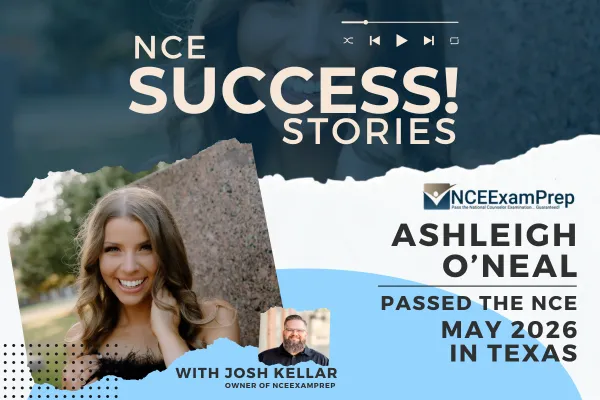
NCE Success Stories Podcast - Ep. 13 - Ashleigh
What does it take to go from graduate student to licensed counselor—and successfully pass the NCE along the way?
In this episode of NCE Success Stories, I sit down with Ashleigh, who shares her journey through graduate school, preparing for the National Counselor Examination (NCE), and taking the next steps in her counseling career.
Ashleigh is both a Licensed Marriage and Family Therapist Associate and a Licensed Professional Counselor Associate. She earned her Master of Science in Marriage & Family Therapy with an additional concentration in Professional Counseling from Texas Wesleyan University in December 2025. Before that, she completed a Bachelor of Arts in Psychology with a minor in Child and Family Studies from Baylor University.
In our conversation, Ashleigh discusses:
Her path into the counseling profession
What graduate school was really like
How she approached studying for the NCE
The strategies that helped her pass
Advice for current counseling students preparing for their own exam
Whether you're in graduate school, getting ready to take the NCE, or simply looking for encouragement from someone who's recently been in your shoes, Ashleigh's story offers practical insights and motivation for the journey ahead.
🎓 Ready to prepare for the NCE with confidence?
Learn more about the NCE Guaranteed Study Package:
https://pass.nceexamprep.com/guaranteedstudypackage
If you enjoyed this episode, be sure to subscribe, leave a review, and share it with another future counselor who could benefit from hearing Ashleigh's story.
Podcast Transcript
[00:00:00] Ashleigh: Foreign.
[00:00:13] Josh: Hello, and welcome to the NCE Success Stories podcast, where we ask a counselor who has recently passed the national counseling exam all the burning questions that you have as you wonder how to pass with confidence. My name is Josh Keller, and I'm the owner of nceexamprep.com and today I have with me Ashley.
Ashley is a licensed marriage and family therapy associate and licensed professional counselor associate. She earned a Master's of Science degree in marriage and Family therapy with an additional concentration in professional counseling from Texas Wesleyan University, graduating in December of 2025. Ashley also holds a Bachelor of Arts degree in psychology with a minor in Child and Family Studies from Baylor University, where she graduated in December 2022.
Did I get all that right?
[00:00:59] Ashleigh: Ashley did, yes.
[00:01:01] Josh: Awesome. Awesome.
[00:01:03] Ashleigh: All right.
[00:01:04] Josh: Yeah. Well, we were talking real briefly before just about that dual degree program. Do you want to share briefly, kind of what motivated you to do that? And then we'll dive into some of the questions related to the nce.
[00:01:17] Ashleigh: Yeah, definitely. So I chose that track because I.
First off, it was only an extra semester, four extra classes, and in my mind, I was like, why not? I'm here. I might as well do it. It will be in the end.
I personally am so glad I did. I got so much knowledge. I was able to know the laws and, you know, kind of the mindset for both licensors and the way that they think, how they operate. And I just think that it is great for marketing as well. I want to know if they have a competent, qualified therapist.
[00:01:56] Josh: So definitely.
Very good. Yeah, that's been my experience as well. You know, some people know the difference. Some, you know, want an mft, Others, you know, want a professional counselor. But just having that background, that's awesome. That's going to serve you really well. So, okay, so when did you pass the nce?
[00:02:17] Ashleigh: Yeah, so I passed back in May, So pretty recently of this year, May 27th.
[00:02:24] Josh: Yeah.
[00:02:25] Ashleigh: And I took it in person, actually. So I found out I passed there.
[00:02:31] Josh: You gotcha. So you. You got the. The score report right there when you went to the checkout counter?
Yeah. Did you look at it right away, or did you.
Did you wait till you got in your car? How did that happen for you?
[00:02:45] Ashleigh: Well, I tried to wait till I got in the car, but I was so excited. So I opened it in the bathroom. I was like, I don't want to open it in front of the people there.
Didn't, you know?
[00:02:55] Josh: Yeah.
[00:02:56] Ashleigh: So I was like, okay, I'll. I'll go to the bathroom. I'll open it and I opened it there, and then I found out I passed. I tried to wait to the car, but I was like, rip the band aid off and do it.
[00:03:07] Josh: Yeah, that's. That's awesome. That's awesome. Did you scream or, like, was your response? I'm always curious how people respond to things like that.
[00:03:15] Ashleigh: I was.
My breath was taken away. I kind of was like, oh, my gosh.
Yeah. Trying to catch my breath, and I just felt like an immense weight was just lifted off of my shoulder, like, automatically.
[00:03:29] Josh: Totally, totally. Don't have to study anymore. Don't have to do any of that. Yeah. Had you already taken your MFT exam?
[00:03:38] Ashleigh: Yeah. So I took that in February and then got married and then came back and studied for the NCE and took that kind of a grueling few.
[00:03:50] Josh: Yeah. Geez. You were really busy.
[00:03:52] Ashleigh: Yeah.
Yeah. So I was very happy to be like, okay, this chapter is closed.
[00:03:57] Josh: Yeah. Gosh, I can't imagine planning a wedding and studying for both of those exams.
[00:04:03] Ashleigh: Yes. It's not impossible, but I would not recommend maybe.
[00:04:08] Josh: Yeah. Yeah. Goodness. Well, you. You did it and succeeded. So what did you do to celebrate?
[00:04:15] Ashleigh: So I went to dinner with my husband that night, and then I got Andy's ice cream, which is, like, my favorite place to go.
So I got ice cream and dinner. And that was really fun because I got to just, like, tell about the experience and. Yeah.
[00:04:34] Josh: Yeah. Well, it sounds like he was a strong support through all of it for you. So talk to me a little bit about some of the strategies that you used as you were preparing, you know, studying. What do you think helped you most on test day? Now walk me through some of that.
[00:04:51] Ashleigh: So the first thing that I used, like, a huge strategy was buying into the mindset that I can figure it out for any exam question, for concepts. Like, I can figure it out, and I will. That was really helpful for confidence when I was studying for the exam because there is so much content and we have strong areas and weak areas.
So that was really helpful. That was honestly, I think my number one great. The second strategy is I would always study as if it was test day. So.
[00:05:24] Josh: Okay.
[00:05:25] Ashleigh: I, you know, took it very seriously. I timed myself when answering the questions.
And I also took the practice exams, like, really seriously, like a simulated exam. That way, nothing surprised me. And, you know, I didn't get to the end, and I was like, oh, I'm, like, using too much time, you know, on these questions.
So that was helpful because I felt very prepared.
[00:05:51] Josh: Yeah.
[00:05:52] Ashleigh: I also would read the Questions out loud, and I would talk myself through the answer. So not just what question I thought was right, but why I thought this question was right.
[00:06:03] Josh: Okay.
[00:06:04] Ashleigh: And then in the exam, I. I had a unique situation because I had accommodation, so I had my own room so I could actually talk. But, yeah, for people that don't.
I. If I was them, I would have mouthed it. You know, just not out loud, but just mouth the questions. That way I didn't let any word pass me by that.
[00:06:24] Josh: Right.
[00:06:25] Ashleigh: Could have helped me not pick the right answer.
And then I also pretended I was a supervisor. So I would pretend that people were bringing me these cases and I was conversing with them about.
And the reason why I did that was because it helped me get into what is the standard of care.
[00:06:46] Josh: Right.
[00:06:47] Ashleigh: As opposed to. Well, what would my subjective. You know, like, love that. Do that in a real situation. But what's the standard of care? What's the ethics and the laws.
[00:06:58] Josh: Yeah.
[00:07:00] Ashleigh: They're looking for.
[00:07:01] Josh: That is such a great and unique way of approaching that. Right. Because as supervisors, I mean, I'm a supervisor, and that's what we have to do. Right.
There is the. This is what I would do in my practice, which isn't always aligned with what the standard of care is. But thinking like a supervisor, I love that it puts you in that mindset. So. Wow. Sounds like you had a very strategic approach to get you there, like, each step of the way.
[00:07:30] Ashleigh: Yeah. So I did that. And then I, you know, like, you talked about. Only answered if I had. Only would change the answer if I had an aha moment.
That was helpful. And then lastly, I would train my brain before I started studying.
[00:07:44] Josh: Okay.
[00:07:45] Ashleigh: And I would drink, like, some juice and some berries before I sat down to study. And then on exam day, I did that right before I went in. And it kind of triggered my brain into, like, study mode.
[00:07:58] Josh: Yeah, I love that.
Yeah. Is that a. Is that a skill that you used, like, in grad school or just something that you picked up doing that?
[00:08:08] Ashleigh: I used it for the MFT exam. Yeah. So that was one of the strategies in the prep course that I took. So I just applied it to this one.
[00:08:17] Josh: That's awesome. I love it. And it. It. I can see why, you know, just having. Having that cue, like, okay, this means we're in brain activity mode. You know, this means we've got that going on. That's. That's really clever. Very cool.
So what was test day actually like for you? You went to a testing center.
How did you move through Some of the stress that you had, did you feel any stress or were you feeling pretty confident?
[00:08:46] Ashleigh: Yeah, I. I wouldn't say I felt stress. I felt nervousness, I think the most.
And so I did a couple things I would. I fueled my body with breakfast, good breakfast on exam morning. And then I got to the testing site early to sort of warm up my brain. So I sat in the car and just reviewed some of your sheets that had charts and things that kind of were short term memory things. I reviewed those kind of as a warm up right before I went in. Gotcha.
I prepared anything I needed for the exam the night before so I didn't have to run around the morning of and forget something. So I had it like just ready to go so I could wake up and just grab it and we're good to go.
[00:09:31] Josh: Great.
[00:09:32] Ashleigh: Didn't talk to others in the waiting room. That was really helpful actually.
[00:09:37] Josh: Yeah.
[00:09:38] Ashleigh: Because it helped me manage my stress, you know, rather than getting into social hour and then having to switch to, you know, like exam mode. So that I kept reminding myself during the exam that it felt like I wasn't going.
Excuse me. I felt like I wasn't passing during the exam. And I kept reminding myself that's normal, like that's part of the process and you're not going to feel like you're passing even if you are passing.
So I kept reminding myself of that. That was really helpful because sometimes people can let that overtake them and then it affects their ability to stay focused.
[00:10:23] Josh: Yeah. It's like their brains trying to psych them out, you know, thinking, you know, worst case scenario. And of course that's going to undermine your ability to, you know, recall all the, the learning that you did. So.
[00:10:35] Ashleigh: Yeah, exactly. So that was something. I really attacked the test. I kept telling myself, you know, staying focused, staying present in the moment.
[00:10:45] Josh: Yeah.
[00:10:47] Ashleigh: I did not spend a lot of time on super hard questions because I knew that there were some that were not going to be counted. And most of the time it's some of those questions that are ridiculously hard.
[00:10:59] Josh: Okay.
[00:11:00] Ashleigh: So I would try my best, obviously, but I wasn't hung up on those super hard questions.
[00:11:07] Josh: Good.
[00:11:09] Ashleigh: And I took the mandatory break.
And then I also would just take a break right before reviewing the questions. Just give myself a minute, breathe. I didn't leave, but I just stayed, you know, gave myself a minute and reminded myself at the end to finish strong. That's the hardest part, you know, of the exam. Finishing strong.
[00:11:31] Josh: Yeah. Not to slack off the last few questions or a Little bit, yeah.
[00:11:36] Ashleigh: So that's kind of how I managed that nervousness. And because of that test day was very smooth.
[00:11:43] Josh: Good, good. Yeah. It sounds like you had just real strong presence of mind through it all.
And, you know, just hearing how you studied, it's no wonder that you were able to approach. To test today like that, because you were treating those simulated practice tests as if they were real exams.
So you kind of knew yourself, you knew what you needed. And, you know, some of those, you know, we all have these isms, right? These. These things that are unique to us on how we respond under. Under stress and tension. And it sounds like your approach to. To studying allowed you to be aware of those so that on a test day they wouldn't throw you like they do some people.
[00:12:22] Ashleigh: Right, exactly. Because the test is so much like mindset component that it is. You know, I would say 80% mindset and 20. What? You know.
[00:12:34] Josh: Yeah, yeah, yeah, definitely, definitely. It's. It's such a huge part. And so being aware of those mind games, that that will happen automatically. Right. We're not bad people. It doesn't mean we're bad students because that happens. It's just. It's just how we. We react. It's kind of that reptilian brain who's, you know, trying to. To protect against threats. So.
Yeah. Awesome, awesome. So what were some of the resources that you used in your preparation to get you there?
[00:13:00] Ashleigh: Yeah, so I stuck to one resource, which was your prep course.
[00:13:05] Josh: Okay.
[00:13:05] Ashleigh: And I followed the recommended study plan. So that was very helpful for me rather than just being super overwhelmed and getting lost in. Where do I start? Yeah, that study plan was really helpful and sticking to one resource because there's so many out there and it's easy, like really jumbled and kind of confused. So that was helpful.
[00:13:28] Josh: Okay.
[00:13:29] Ashleigh: I would review the rationales for the right and wrong answers. That was, I think, one of the main things, no matter if I got it right or wrong, reviewing every single question and all of the rationales, not just right.
[00:13:44] Josh: Yeah.
[00:13:46] Ashleigh: Along with the study manual and then taking the practice exams and the quizzes. Good. Oh, yeah, I hit those pretty hard.
And then I would read your charts out loud.
[00:13:58] Josh: Okay.
[00:13:58] Ashleigh: So I went back there and found them in the chat and stuff like that. So I would read them out loud and then I would skip around videos for any, like, weak concepts or weak chapters.
Yeah. So rather than watching like the whole entire videos, I would just skip different concepts, and that was really helpful.
[00:14:20] Josh: Good, good. I'm glad that that's how you use the videos.
There's a lot of videos. Right. And I think sometimes it can be overwhelming just, you know, because there's hundreds and hundreds of hours of videos. So being able to focus on just your weakest concepts, I think that's a great approach to that.
[00:14:36] Ashleigh: Right, yeah. And along with the weaker concepts, I also spent more time on the areas that had higher percentages of questions on the exam.
[00:14:46] Josh: Yeah.
[00:14:46] Ashleigh: So that was very helpful because I kind of paired that with my weaker percentages in my own study plan.
[00:14:55] Josh: Yeah.
[00:14:55] Ashleigh: And, you know, that was beneficial for me on exam day. And then, of course, I used my accommodations on the actual test, and I'm so glad I did the same for the mft. So I use them if you can't. If you are able to get them, use them.
[00:15:11] Josh: Yeah, totally. Yeah. I think that a lot of people, for some reason, they feel some sort of like, you know, hesitation to do that, like they're admitting, you know, they're weak or something like that. But it's, It's. It's just a way of accommodating. That's why they call it an accommodation, a way of accommodating, you know, a need that you have. And so I think if there's any chance that it could work for somebody to do that, they should, because it's just. Just a little edge. Right. Even the. Even being able to, you know, speak the. The question and answers out loud like you were describing, you know, that's what some people need to be able to do. So. Love that. Very great. Yeah. So is there anything that you would do differently if you were to.
You don't have to take the test again, thank goodness. But if you. If you're looking back on it, is there anything that you would do differently?
[00:16:04] Ashleigh: I would. So I did it in 30 days.
I would have taken more time. Yeah, I did three days. And looking back, it was kind of what I needed to do and had to do. But I. I would have done that kind of 60 day. I think that's the perfect format and timeline because I think there's such thing as spending too long.
[00:16:26] Josh: I agree.
[00:16:27] Ashleigh: Getting, like, burnout. But then, yeah, I maybe would have not done it in 30 days. But, yes, I. I did start, though, to burn out a little bit towards the end. Like, I will be honest with that. So I would have backed off, had a bit more time, you know, to just review some short concepts in the final days rather than, you know, hitting it hard.
[00:16:51] Josh: Yeah.
[00:16:52] Ashleigh: And this isn't necessarily something I would have done different. But it's something I, I, I kept having to kind of pull myself back and remind myself that I am, you know, I'm trying to study every detail that is just not possible.
[00:17:11] Josh: Right.
[00:17:12] Ashleigh: Telling myself that I'm not going to know every single thing on the exam. And that's okay. Like, that's, you know, there's no.
Because I kept on getting caught up in that and trying to study everything.
[00:17:25] Josh: Yeah, yeah. Taking some of that pressure off to get it all Right. Right. We kind of have to learn this word enough. Like this is going to be enough. And that, that can be terrifying for some people. Right. Because that may not be how they function normally.
[00:17:40] Ashleigh: Right. Yeah. And the good thing is that if you know how to read the questions and answer the questions, even if you maybe don't necessarily know the answer, you can find that there's that mindset again, you can figure out. And that's exactly what would happen on some of the questions.
[00:17:56] Josh: Yeah, Yeah. I think that's why, I mean, you've referenced a lot of the answering methodologies that I teach in the course, and I think that's why that's so important but often overlooked. And then being able to apply those answering strategies in the practice tests as well, not waiting until the actual NCE to put those into play, but let's practice using them ahead of time so they become very natural by the time we get to the actual test.
Yeah. Okay.
So if you had 30 seconds to share with a test taker something valuable or encouraging, what would you want to impart with them? If you only had just 30 seconds to, to give them a gift of wisdom and knowledge, what would that be?
[00:18:40] Ashleigh: Yes, I've got it. I'm ready for it. Okay.
Mindset is a huge component of the test, like, as we talked about. So make studying fun.
It's very important to make it fun. Think about being open to learning something new each time you sit down. Study.
Approach it with curiosity. If you approach it with curiosity, it's going to be way more enjoyable for you and have a life outside of studying. It's so, so important. I made that mistake with the mft and so I now realize, like, it is so important to have that life outside of studying and the relationship that you form with the exam. It's going to be a positive one or a negative one.
[00:19:25] Josh: Sure.
[00:19:26] Ashleigh: Make the effort to make it positive. And so great.
[00:19:31] Josh: Yeah, that is wonderful advice. I love that. It's, it's just, it's all about balance, and I think that you describe that really, really well.
Just so we're not. It's a serious exam, but we don't need to take it so seriously that we can't still have fun and. Yeah. So good.
[00:19:50] Ashleigh: Yeah. Especially if you're doing that 60 day window. You know, it's, it's a long time. So. Yeah, make it a good time.
[00:19:58] Josh: That's right. Yeah, it's a long time. Make it a good time. That could be a new catchphrase maybe.
[00:20:03] Ashleigh: There you go.
[00:20:04] Josh: Awesome. Well, Ashley, thank you so much for joining me for this. This has been really helpful. I have no doubt that our listeners will benefit from it. Real quick, I know this wasn't in the list of questions I gave you, but what's next for you in your career?
[00:20:17] Ashleigh: Yeah, so the goal is to start my associate. So ideally I would love to do part time in a private practice in part time at a psych hospital. I had experience with that. Absolutely loved it.
So that's sort of the next steps and working towards getting those 3,000 hours out of the way.
[00:20:39] Josh: That's right. That's great. Well, I wish you the best.
Again, congratulations on passing both of those tests and your, your new marriage. I hope all that goes well as you get you started with your new career and your new marriage.
Amazing. Amazing.
[00:20:54] Ashleigh: So thank you so much for having me.
[00:20:56] Josh: Yeah, it's been great.
NCE Exam Prep seeks to provide quality, reliable and easy to use preparation material to help test takers confidently pass the National Counseling Exam. For more information, go to nceexamprep.com.
NCE Exam Prep seeks to provide quality, reliable and easy to use preparation material to help test takers confidently pass the National Counseling Exam. For more information, go to NCEexamprep.com.

What Are Our Customers Saying ?
How We Are Trusted,
See What They Say Bout Us

Sara Meeter
I thank you for all your help and your program. This was my fourth time taking the NCE and because of your program I passed!Thank you so very much!

Lynne Boyette
Yesterday, I took my NCE exam and passed! I guess there is hope for someone who graduated with their masters 23 years ago!
Katherine
I passed last week & wanted to thank you for all your help in doing so! The practice exams helped TREMENDOUSLY with becoming more confident in test taking! Good luck to anyone taking it soon!